Adding New Rules
's Rules engine allows administrators to apply client-specific business logic to positions during the sync process. Rules are structured as If/Then statements and run after company, skill, and flex mappings have been applied. Rules can be assigned either account wide or at the credential level, and each rule is assigned a priority number that determines the order in which rules are applied.
Administrators with elevated permissions can create, edit, and delete rules directly in VMS Sync Admin Tools without contacting VMS Sync Support.
Follow the steps below to add a new Rule.
- Open the Rules Dashboard by clicking Rules in Admin Tools.
- Click Create +.
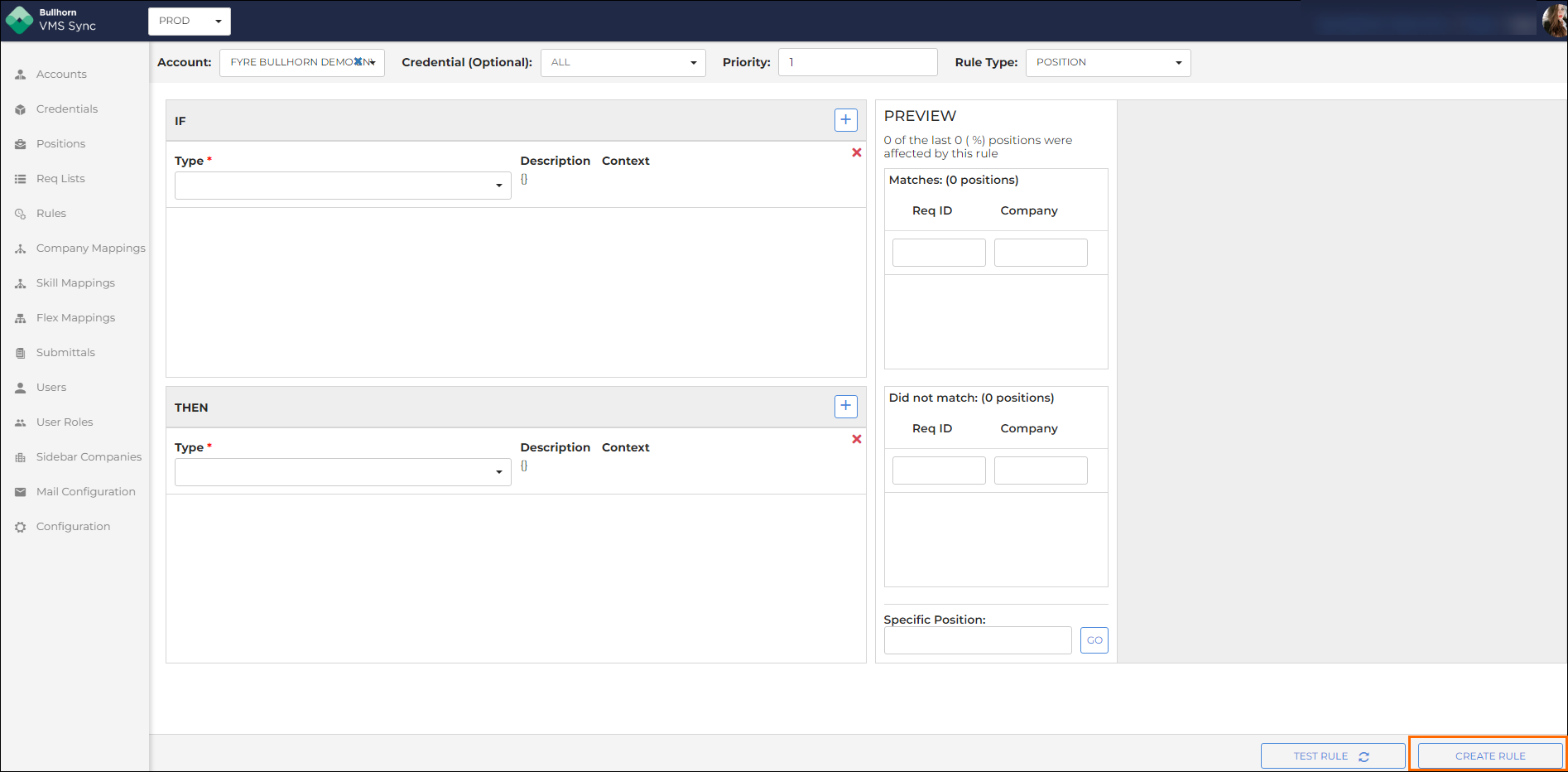
- From the top navigation bar, if appropriate:
- Select the Credential (Optional) dropdown, and choose a Credential.
- Select the Priority dropdown, and increase or decrease the Priority.
- See Rules Best Practices for more information on Priority.
- See Rules Best Practices for more information on Priority.
- From the IF section, select the appropriate value from the Type dropdown.
- If you have additional IF conditions, click the + .
- The rule applies only when every IF condition is met.
- You can remove all conditions so the rule will always apply.
- Common IF Types:
- indexOf: Field contains value
- exactMatchTest: Field contains exact value
- regexTest: supports regular expressions and multiple keywords
- inverseRegexTest: same as regex but uses IS NOT logic
- isSet: field has a value (is not blank)
- notDefined: field is blank
- From the IF section, select the appropriate value from the Field dropdown.
- The dropdown contains available VMS fields.
- VMS Sync doesn't look at ATS Job values to set rules.
- For additionalDetails, use the exact spelling and case.
- You can confirm format when JSON populates after testing rule.
- From the THEN section, select the appropriate value from the Type dropdown.
- If you have additional THEN conditions, click the + .
- Common THEN Types include:
- setIgnore: position ignored
- replace: set field to value of another field
- Almost always used to set ATS field to VMS value
- Can also be used to manage blank VMS fields
- setTo: set field to static value
- Commonly used to set ATS values directly
- template: set field to multiple values (supports EJS formatting)
- Commonly used for description and email templates
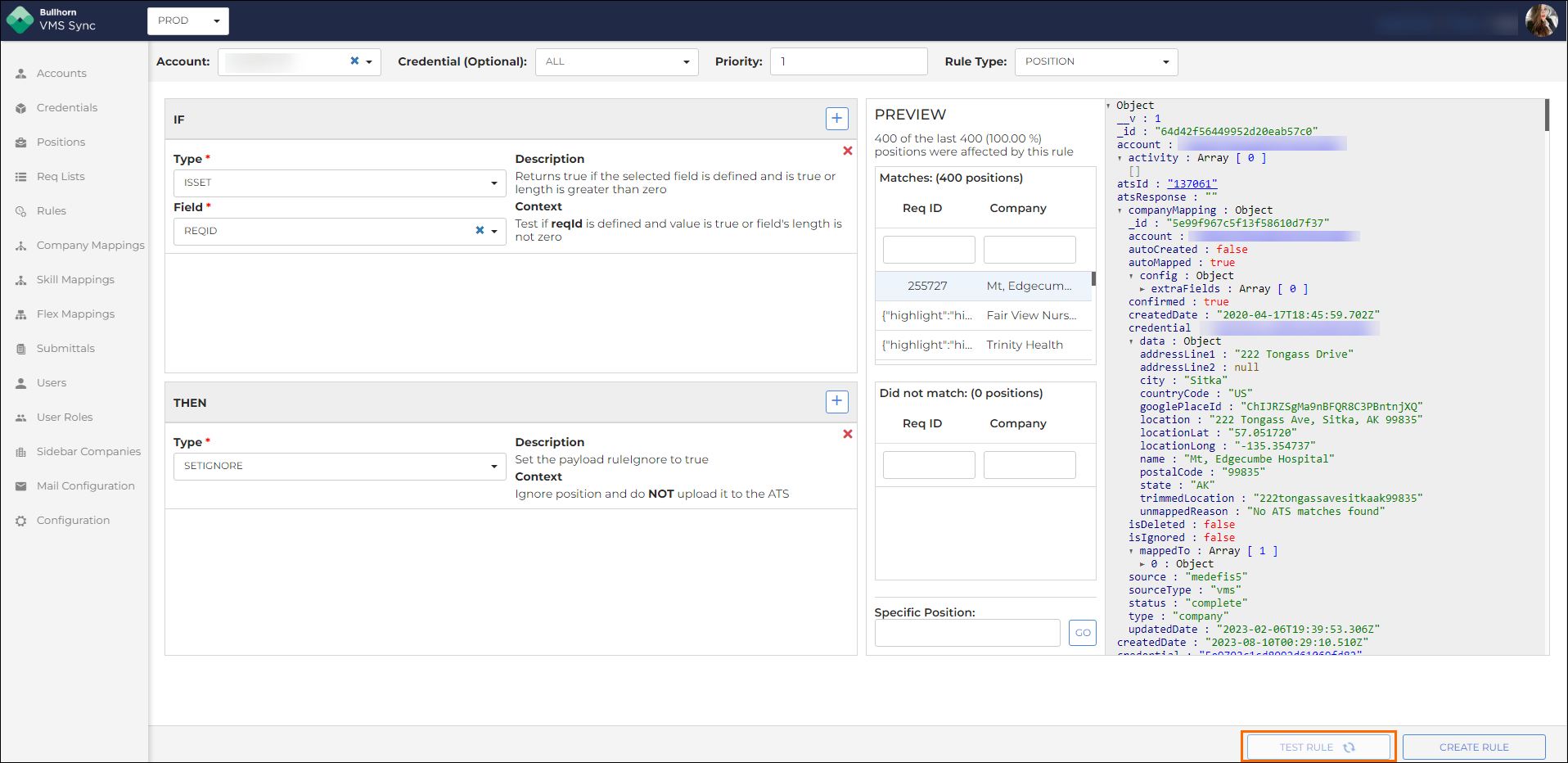
- Click Test Rule.
- The preview will show the recent positions the rule was applied to.
- Click a result to view the JSON with highlighted values (IF = Blue, THEN = yellow).
- You can use the Specific Position field to test a specific req ID.
- Click Create Rule.
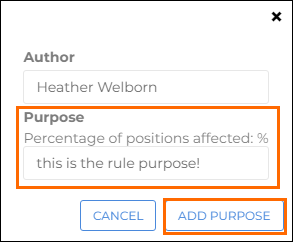
- In the Purpose section of the pop-up, enter text to describe the rule and click Add Purpose.
- Example: Priority = High
- Example: Priority = High
Was this helpful?