| Edition: Enterprise | Audience: All Users |
Example Trend: Resource Allocation
A particularly creative use of Trends is to monitor overall trends and compare related metrics to understand market trends and to prepare accordingly. Consider how certain ratios or activities might relate to each other (not correlate) and you can spot emerging trends early. For example, jobs per head could be an indicator of customer demand, and CVs per job an indicator of how hard recruiters have to work to service jobs.
What this Trend Does
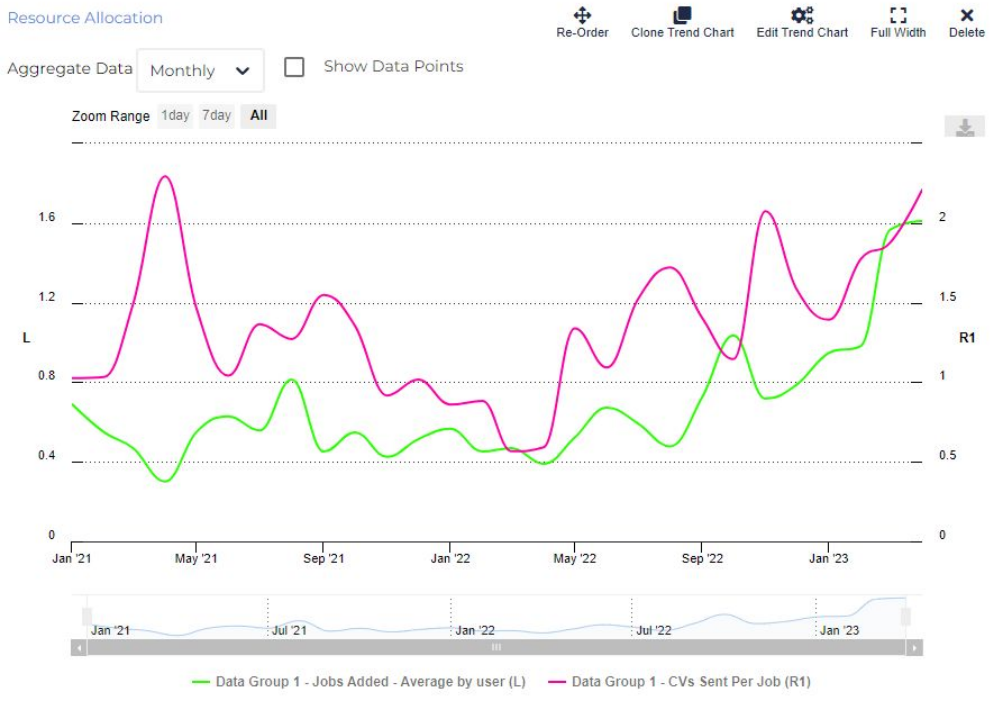
This trend depicts Jobs Added per user and CVs Sent per job on two axes. These are both effectively ratios, which means they don’t simply show metric counts and are instead indicators of quality/performance.
A viewer may interpret an increase in jobs per head as a positive market sign, and would need to monitor CVs per job to ensure they get sufficient coverage. If CVs per job dropped, they may want to hire new recruiting or sourcing staff.
Features Used
- Ratios: It’s not just metrics that are interesting on a timeframe trend. Ratios are a strong indicator of quality and are equally important to measure. If the desired ratio isn’t in the standard set, create it in-situ for this trend. Get creative!
- Dual Axis: Whilst not strictly necessary for this, as the metrics are on a similar scale, the dual axis brings the lines closer together and makes it easier to spot the interplay between the trendlines.
- Average Per Head: Particularly when trying to track overall shifts either in business or the market, averages per head are more reliable for removing some of the noise, especially if the company size has fluctuated. You don’t want an increase or decrease in heads to provide misleading conclusions.