"Reuse Previous Answers" Screener Setting
This feature is currently in early access.
The Reuse Previous Answers setting lets you configure Amplify Screen to offer candidates the option to skip questions they have already answered in a previous screening, reusing their previous answer instead.
When enabled, the screener checks past screening transcripts and identifies questions a candidate has already answered in screenings for other jobs. Rather than asking those questions again, the screener offers the candidate the option to skip them and use their previous responses for the current evaluation. This reduces friction for candidates who apply to multiple roles, while still producing a complete screening summary for recruiters.
How “Reuse Previous Answers” Works
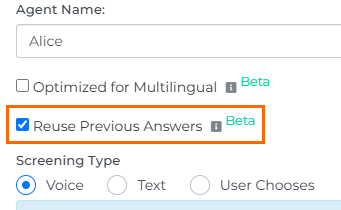
The Reuse Previous Answers setting is found within your screener Question Settings. To enable it, open your screener engagement, select the Screener question step to open the Question Settings, then check the box next to Reuse Previous Answers.
If this Setting is Not Enabled:
-
Every screening asks the full set of questions, even if the candidate has answered them before.
-
Candidates may experience repetitive questions across multiple screenings.
If this Setting is Enabled:
-
The screener reviews past screening transcripts linked to the candidate from other job applications, based on Job ID, that were completed within the last 30 days.
-
Transcripts older than 30 days are excluded.
-
Questions already answered in previous screenings for different jobs are skipped.
-
Previous responses are included in the scoring process and added to the transcript in the summary report.
-
The summary report indicates which answers came from previous screenings, including the originating job and date.
The Reuse Previous Answers setting does not apply to retakes. If a candidate retakes a screening for the same job, they will not be offered the option to reuse answers from a previous attempt and will be asked all questions again.
Candidate Notification and Consent
When the screener identifies any reusable answers from a previous screening, the candidate is notified before the screening begins.
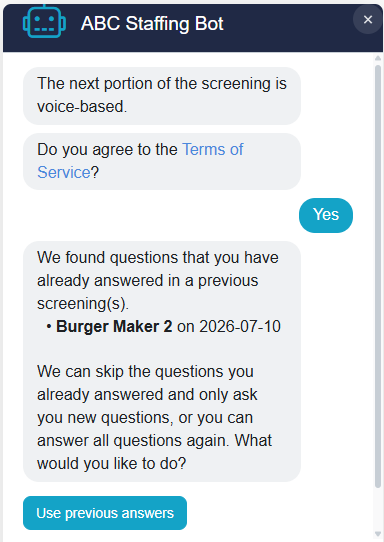
The notification includes the job and date of the prior screening and presents the candidate with an opt-in choice:
-
Use previous answers: The screener skips previously answered questions and only asks new ones.
-
Answer all questions again: The screening starts from scratch with the full set of questions.
Candidates cannot selectively choose which individual answers to reuse. This keeps the experience simple and consistent.
If the candidate chooses to reuse answers and all questions would be skipped (because every question was already answered in a previous screening for a different job), the candidate moves directly to the next step configured in the engagement.
If the Optimized for Multilingual setting is enabled, the notification and opt-in process is also supported in the candidate's language.
If you enable this feature, consider adding language to your screener invite emails or texts letting candidates know they may have the option to reuse previous answers. You should also include contact details in case they want to request a transcript from a previous screening.
Here is an example you can adapt:
"If you have previously screened with us, you may be offered the option to reuse some of your previous answers. If you would like a copy of any previous screening transcripts, please contact [email/phone]."
Question Matching Relies on Screener Interpretation
The screener attempts to identify whether questions have been answered based on intent rather than exact wording. This allows greater flexibility to minimize question duplication across screenings, but it also means there's room for interpretation error.
Low risk scenarios:
-
Previous question: "Are you willing to relocate?"
-
Current question: "Would you be open to moving?"
-
The screener will likely recognize these as the same question and skip it.
High risk scenarios:
-
Previous question: "Do you have management experience?"
-
Current question: "Have you managed a team of 5 or more people?"
The screener may treat these as the same question, although one is broader while the other requires specific scope.
FAQ
Will the screener reuse answers from surveys, chats, or LinkedIn Apply?
No. This feature only checks past Amplify screening transcripts.
How does the screener decide whether a question has already been answered?
The screener reviews previous screening transcripts and evaluates whether the candidate provided a relevant answer based on question intent, not exact wording. If the question was answered, it's skipped. If not, the screener asks it again.
What happens if I change the wording of a question slightly?
The screener evaluates whether the intent of the question matches a previous response, not just the exact wording. If the meaning is similar enough, it may skip the question. If the wording change alters the intent significantly, the screener asks it again.
What happens if a candidate retakes a screening for the same job?
All questions are asked again. The screener only checks transcripts from other job applications (based on Job ID) when deciding whether to skip questions. This ensures candidates can provide fresh answers when retaking a screening for the same role.
What happens if all screening questions would be skipped?
The candidate still receives the same notification and opt-in choice. If they choose to reuse their previous answers and no new questions remain, they move directly to the next step in the engagement.
How long are previous answers valid for reuse?
Previous screening answers are valid for 30 days. If a candidate's most recent screening for a different job was completed more than 30 days ago, those answers are excluded and the screener asks all questions.
How will I know which answers came from previous screenings?
The screening summary report indicates which responses were reused from previous screenings, including the originating job and date.
Is there a difference between voice and text-based screening for this feature?
No. The screening logic is identical across both. The only difference is the format presented to the candidate.